Loading...
Gadget by The Blog Doctor.

Friday, April 25, 2008

What does a new EFL teacher need to start his/her career successfully?

A teacher needs not only a requisite knowledge of how the English language works and how to teach the four skills: reading, speaking, writing, and listening(The Practice of English Language Teaching by Jeremy Harmer is one of the most comprehensive books in the subject) but also a suitable awareness of the various teaching methods and principles that are or were employed.
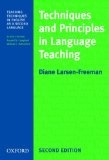
For a practical synopsis of these trends and methodologies as well as an explanation of how they are applied in the classroom, Techniques and Principles in Language Teaching by Diane Larsen-Freeman is an established reference.

A teacher's job involves much more than just preparing a lesson plan. This is only part of what a teacher has to do on a daily basis. If you are endeavoring to become successful, you need to be an expert on how to manage your students and keep them focused and motivated, on how to deal with problem students, on how to get along with your colleagues, the school administration, the parents, etc...
Although some of these skills come with time and experience, one interesting book that tries to provide answers to all the matters mentioned above and more is
The Unauthorized Teacher’s Survival Guide by Jack Warner and Clyde Bryan, with Diane Warner
It is a must-read for every wannabe successful teacher.
In coming posts, I will write about some of the tips that the book offers to us. However, to fully take advantage of the book, consider buying it. It is worth every penny!
That is, in my view, a great place to start with. I do not claim that other books are less important or less comprehensive. I really hope other colleagues will suggest their own list of good references and tips.


Saturday, April 19, 2008

How to encourage beginners to use English while sitting in groups?

This is inspired by Victoria's comment on a previous post.

Students should be encouraged to use English not only to do a task but also to interact with one another while they are doing the task. This is a real opportunity for the students to use the language for a real purpose. We mustn’t throw it away.
"Social skills such as acknowledging another's contribution, asking others to contribute, and keeping the conversation calm need to be explicitly taught." (Section on Cooperative Learning)
Diane Larsen-Freeman's Techniques and Principles in Language Teaching

If you are teaching beginners, the interaction has not to be complicated. You can limit it to some very basic social skills. You can actually start by doing a pre-group work activity. Just bear in mind that learning to work in groups usually stretches over a quite long period. Therefore, you can teach your students one or two things at a time.
Example activity:
Step1:
For instance, you can start by teaching them how to ask for their turn if they are playing a language game or doing something together. Think of unchallenging phrases like:" Now, it is my turn", "is it your turn?", "who is next?",etc…
You can start by asking how your students say it in their language. Then you provide the equivalent in English. You can write the expressions on the board and have your students repeat after you.
Step2:
Next, you can teach them how to encourage each other during an activity or when they finish it. Think of expressions like "Nice Job!", "Excellent", "that's good", "Well done", "Perfect!" etc...
Step 3: sitting in groups
After that, you can ask your students to sit in groups and give them flash cards with the expressions in step1. Some of the flash cards will have the words in English written on them. The others will have the words in the students' native language or pictures/illustrations, etc...
Explain that the students have to match the phrases in English with those in their language. Make it clear that they should encourage each other using words from step two.
To encourage this behavior and make them refrain from using their native language, you may tell your students they will only get points if they use English.
Keep a checklist/ form (grading/points) and go from one group to another to make sure they do use English.
Remember that you can model this by encouraging your students in English when you go from one group to the other. By habitually doing this, your students are more predisposed to learn it.

Thursday, April 17, 2008

The dynamics of group work

Problem: Whenever I assign a group work activity, the classroom turns into a disorderly panic-stricken place. How do you manage to control yours?

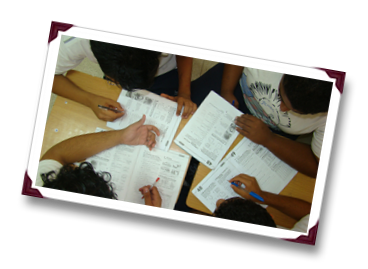
Answer:That is a typical question about a classic situation. In fact, many teachers find it difficult to have power over students working in groups. The good news, however, is that controlling group works is feasible as long as you follow the right steps. Here is a straightforward sketch of these steps. It is only meant to serve as a hands-on guide about dealing with group work. To learn more about the rationale behind cooperative learning, its dynamics, and the various activities that teachers can apply in their classrooms, there is a list of recognized references for you to consider (below).

Step 1-Before starting
Before starting a group work activity, we should make sure our students are aware of the benefits of working together and relate this to real life: we can start by telling a relevant story or a local proverb. Group work is a kind of social interaction. Therefore, we have to make sure our students can communicate with each other in English. Relevant questions that are going to build the students' interactive skills include:
What do you think of...?
Do you think that...?
Why is it important to....?
Do you agree that....?
What is your opinion concerning....?
Do you share his opinion?
These questions are only examples. What students will need depends on the task in question and their level.

Step 2-Assigning Roles
For our task to be successful, we have to make sure that nobody is left out of the group and that everyone will have a simple defined role: many teachers have come up with different names for those roles but they are basically the same. Here are a few:
Note Taker or Secretary
Presenter ,Spokesman or Reporter
Timekeeper
Idea Generator
Noise Watcher
Speech Organizer
One can use these or invent her/his own roles. Nevertheless, we should always make sure that the roles do more or less fit the members' personality and level and that they are not similar. Asking the shyest person in the group to be the spokesman may not always the best bet.

Step 3- Tolerating Some Degree of Noise
Noise is not always supposed to be negative. In fact, it can be tolerated as long as it is kept to a low level. If it interferes with and annoys the other groups, one group is said to be "negatively" noisy.The noise will be there inevitably. But it has to be controlled and kept to a minimum. One good way to reduce noise is to ask one of the members to be the noise-watcher. The student will keep eye contact with the teacher and tell the group if they are exceeding the permitted limits. Some teachers keep a whistle to signal the level of noise is too high. Keeping colored cards to draw attention to the level of noise is also another conceivable option. A red card means the group is too noisy.


Step Four- Less Interference is Better
While the groups work, we should try to keep our presence as imperceptible as possible. Interfere a lot and you will make the groups less concentrated on their task. Interfere less and they are more productive. Does this mean we just sit down and "let the kids play"? No, the teacher has to go from group to group, listening, helping, giving feedback and making sure they are not loosing interest or ignoring the activity. We may want to be unobtrusive because we want to make the students take responsibility for their own learning, interact using English, and try to solve their problems by themselves. We may want to be there, however, in case they began to loose focus, they need more clarification, or have problems that they cannot resolve by themselves.

Step Five- Time management
It is important to set a time limit. We ought to make sure the task is feasible within that time limit. Doing a group task that will never be presented to the class because the bell rang is as detrimental as doing nothing at all. So we must let it be clear that the students have to finish in time. When they finish, the reporters will "report" their work to the rest of the class. After that, we can thank the groups for their efforts and make them see the worth of their cooperation. This will encourage them to make more effort and enjoy it when you decide to do more Cooperative Learning later.

Step Six: Fair grading
Fair grading is a major concern for teachers especially when using Cooperative Learning. How can we decide whether all the members worked evenly during a group activity? What should we really grade, the students' work as a whole or their individual contribution to the group work? Generally, group work should not only be about the product. It is also about the process. We shouldn't only grade the product because it may not reflect the members' contributions to the group. We have to make sure to include a kind of peer assessment form using a simple point system. The students are required to assess the involvement of their peers but they may also be asked to assess themselves. This will help the teacher to decide whether the grades are consistent later. Having our own group assessment form with the names of the groups and the members and assigning points as we go from group to group will also help us get a more accurate grading system. This, added to the product itself, will make a good basis for a fair grade.


References:
Techniques and Principles in Language Teaching by Diane Larsen-Freeman (Second Edition)
(For a short and snappy explanation of what Cooperative Learning is about + a practical example)
Cooperative Learning: Resources for Teachers by Spencer Kagan
Cooperative Learning (Second Edition) By R. Slavin
A Guidebook for Cooperative Learning by D. Dishon and P. W. O'Leary

Schreyer Institute for Teaching Excellence, "Commonly Asked Questions about Teaching Collaborative Activities


From the Internet:
http://www.eric.ed.gov/

Monday, April 14, 2008

Teaching Writing: a practical example

To get it started, I am going to talk about a writing activity I taught a month ago. First, I am going to give you an idea about the class I teach.
Number of students: 33.
Age: from 11 to 14.
English sessions per week: 5.
Session: 50 minutes.
Years learning English: 4.
English taught as: second language


Book: The World through English II
Topic:
Write a letter to a local newspaper about pollution in your city.

This activity feeds sensibly on a previous reading activity. In a previous session, students read a letter to a local newspaper about the changes that may take place in Takuana Island. The writer of the letter informs the newspaper's readers that the claims about the changes (building new factories, airports, cutting down the rainforests, etc...) being harmful to the island are rather unfounded.
The fact that the writing activity comes after a reading activity is central. The reading activity serves as a model for the students to follow. Besides, it provides them with the active vocabulary that will be used afterwards.
First, I referred my students to the layout of the letter in the reading activity. We discussed the difference between a formal and informal letter. I quickly remarked that they do not only differ in terms of content but also in terms of layout. I asked my students where the various parts of the letter are:
Where is the address of the sender?
Where do we place the date?
How do we open a letter?
How do we close it?
Next, I presented a few conjunctions to my students (while, when, because, whereas, although, though). I presented their use and asked my students to work in pairs to put some sentences I wrote on the board together.
Later, I asked my students to sit in mixed-ability groups of four and fives. (The dynamics of group work will be discussed in another post).
I gave my students envelopes. In every envelope, I enclosed a letter that was cut into pieces (address on a small piece/ date on another /Dear Sir/Madam /Yours Truly/etc...). I asked them to put the pieces together.

Then, we proceeded to talk about the content. I used a few visuals about the manifestations of pollution: factories/ sea pollution /dead animals / cars and traffic jams, etc...
I asked my students to comment on those visuals: I wrote their words on the board. This served as a brainstorming session. Then, I draw a circle in the middle of the board. I asked my students about the topic. I wrote "pollution in my city" inside the circle. I drew three rectangles: causes – consequences – suggestions. I asked the students to write ideas under each rectangle. When they came up with a list of words under each heading, I asked them to work individually to try to write their first draft of the letter. I remarked that they do not have to care too much about grammatical mistakes at this stage.
Next, the students were asked to consider the content, organize their ideas, use the appropriate conjunctions, change words, etc... I asked them to use the Proofreading Checklist. (I will also come back to this in a coming post).
After that, students handled their papers to their partners to check for grammar, punctuation mistakes, if any.
As a last step before writing the final draft, I checked and explained some common mistakes.
After finishing the activity, I made sure we listened to some of the letters. Some of letters were also published later in the classroom's magazine of English.

EFL teachers staffroom!

Have you ever struggled with an activity and wondered how it could be taught? Maybe you have browsed the internet only to find that the mass of downloadable lesson plans just doesn't meet your specific needs. It would even have made you lose time trying to find a more or less similar activity. Do not worry! Many of us have been there, too.
This is exactly where the idea behind this blog came from. If one of us has difficulties or is out of ideas on how a specific activity or a lesson should be taught, she/he can post it here. We can discuss it together and come up with a variety of creative and feasible suggestions, hopefully!
Therefore, this blog will not concern itself too much about theory, though a little background information will not do any harm as long as it is there to support our ideas rather than overshadow them. This blog's primary purpose is to make available concrete ideas for teachers on how specific lessons or activities may be approached.